The first church nearly died in committee.
Maybe that’s an overstatement, but perhaps not by much. Acts 15 describes a business meeting that could have strangled the Christian movement in its infancy. Gentiles were coming to faith through Paul’s and Barnabas’ ministry, but teachers from Jerusalem insisted these new believers must be circumcised and follow the Mosaic law to be saved. The conflict was sharp enough that the Antioch church sent Paul and Barnabas to Jerusalem to sort it out with the apostles and elders.
What happened next is one of the most consequential moments in church history and offers something vital for how we think about the Spirit’s work in gathered bodies of believers.
The Jerusalem Council didn’t resolve quickly or easily. Luke tells us there was “much debate” before Peter stood to speak. The apostles heard testimony from Peter about Cornelius, from Paul and Barnabas about what God was doing among the Gentiles. James consulted the prophet Amos. They wrestled with Scripture, with experience, with each other.
Then came the breakthrough. The Council reached a conclusion they articulated in this remarkable language: “It seemed good to the Holy Spirit and to us …” (Acts 15:28).
That phrase deserves our attention. The apostles didn’t claim the Spirit bypassed their deliberation. They didn’t say the Spirit handed them the decision. They didn’t say they took roll call, held a vote and the Holy Spirit rubber-stamped it.
Transformation came through their honest wrestling, their testimony, their scriptural reflection, their debate. The Holy Spirit worked in the business not around it. Wesley noted this in his commentary on Acts 15, observing that “we need not suppose their inspiration was always so instantaneous and express, as to supersede any deliberation in their own minds, or any consultation with each other.”
The result was organizational clarity that released the church for mission. The door to the Gentiles was opened wide. Paul’s subsequent journeys, the spread of the gospel across the Mediterranean, the eventual emergence of a global church ... all of it flows through that opened door. Each of us reading this article is downstream of what happened when that Council engaged in holy, Spirit-infused debate together.
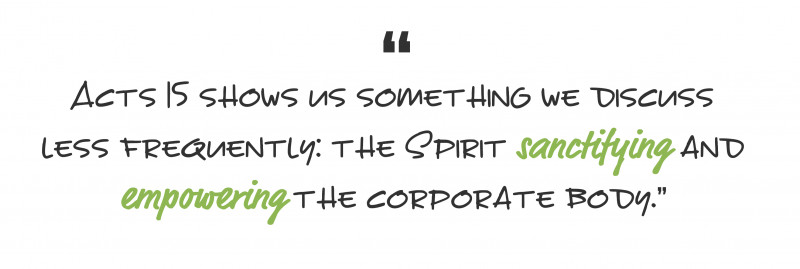
We talk often about the Spirit’s empowering work in individual believers. We preach sanctification as God’s transforming grace in our personal lives. Acts 15 shows us something we discuss less frequently: the Spirit sanctifying and empowering the corporate body.
Consider what happened to the church as an organization at Jerusalem. It was cleansed from a false requirement that would have strangled the gospel. It was set free from a burden that hindered mission. It was empowered to move into territory it couldn’t have entered otherwise. That’s sanctification language applied to a body, not just a person.
The Spirit’s work at Jerusalem wasn’t merely informational, telling them what to believe. It was transformational, making them into a body capable of a mission they couldn’t have undertaken in their previous state of confusion. The Council that gathered in uncertainty left with clarity, power and a renewed focus on the Savior’s great mission — to reach the ends of the earth.
Notice this, as well: the way the Jerusalem Council delegates approached their work seems essential to the outcome. They came to Jerusalem not having already decided their opinions on the matter. They came with genuine questions, genuine conflict and genuine desire to allow the Spirit to lead them somewhere they couldn’t have reached relying on their own human preferences, opinions and understandings.
This posture differs from arriving with entrenched positions and debating until one side “wins.” It differs from treating deliberation as a “necessary evil” we must endure. The Council at Jerusalem was open to listen and be led, corrected and surprised by one another and by the Spirit.
Notice too what’s absent from the account. No one attacks Peter’s character for eating with Gentiles. No one accuses Paul of selling out the faith. No one suggests the Jerusalem leaders are motivated by pride or power. The debate is vigorous, but it stays focused on the question rather than the questioners.
When a body of believers gathers with that kind of openness, something becomes possible that wasn’t there before. New doors can be opened. Christ’s great mission advances. The harvest field opens in new spaces.
The Wesleyan Church gathers periodically to seek the Spirit together in district and general church conferences. We deliberate, debate, hear testimony of what God is doing, consult Scripture and attempt to discern the Spirit’s leading for our denomination.
But Acts 15 shows us these gatherings can be more than business meetings. They are occasions for corporate sanctification and empowerment through the business. When we genuinely seek to wrestle through weighty matters while also listening to the Spirit’s voice together, we position ourselves to receive clarity and power we could never manufacture on our own.
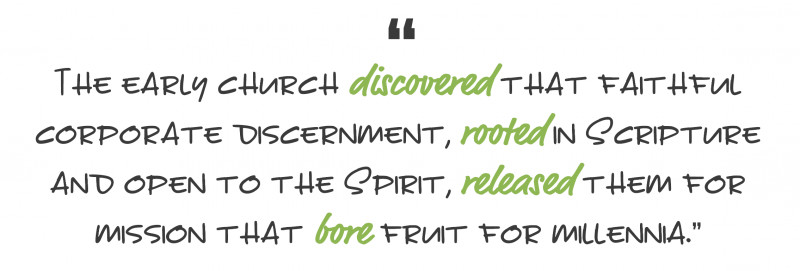
The question for any such gathering is whether we come seeking to be transformed as a body, or merely to defend our positions and conduct our business. The early church discovered that faithful corporate discernment, rooted in Scripture and open to the Spirit, released them for mission that bore fruit for millennia.
We are that fruit. What doors might open for the message of salvation and holy transformation if we come seeking the Spirit together with the same posture?
Holy Bible, New International Version®, NIV® Copyright ©1973, 1978, 1984, 2011 by Biblica, Inc.® Used by permission. All rights reserved worldwide.